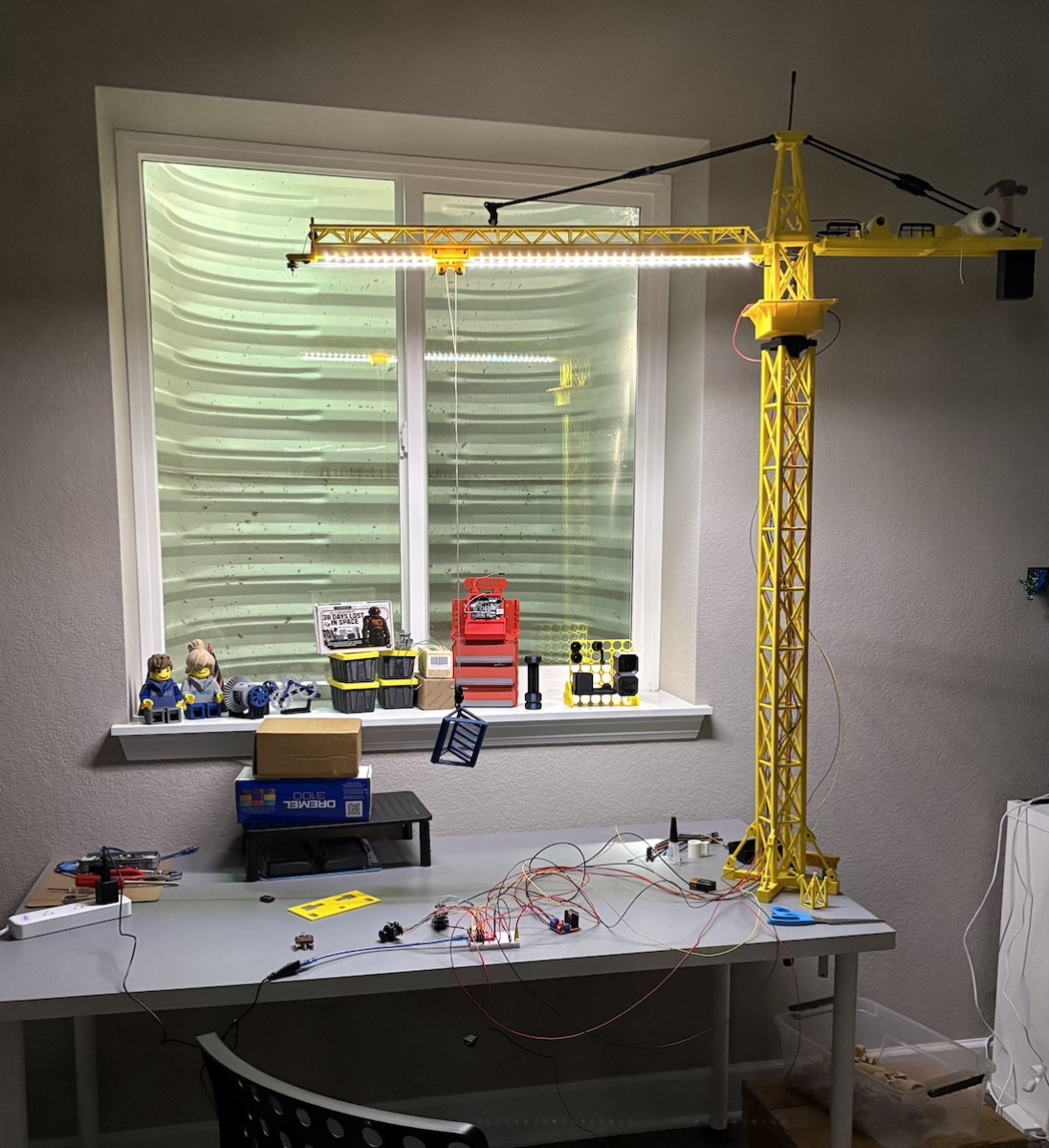
If I couldn’t pull this off, I wasn’t a maker — I was just a guy with a 3D printer and a dream.
That’s the thought that ran through my head as I stared at the Thingiverse page for an RC tower crane. I’d seen it before, months earlier, bookmarked it, and moved on to something safer. Smaller. More within reach. But this time, something was different. I didn’t bookmark it. I hit download.
I didn’t have a plan. I didn’t know what I was going to do with a tower crane once I built it. I just knew I needed to build something that scared me a little. Something that would prove — to myself, mostly — that I could do more than follow tutorials and print other people’s designs.
So I started printing parts. Pro tip: don’t skip the fundamentals. Learn CAD & 3D Modeling and spend real time getting familiar with your slicer with Slicer 101.
Also, curious about the legal side of downloading and remixing STL files? I wrote a deep dive on the 3D printing sharing economy — it covers licenses, platforms, and what you can actually do with that free design.
The beautiful mess
The first week was chaos.
Parts everywhere. Failed prints in the corner. My basement workshop looked like a crime scene for geometric shapes. I’m pretty sure my wife walked past one evening, surveyed the wreckage, and silently calculated how long she’d tolerate this before staging an intervention. My kids were unsure what I was doing and why.
But here’s the thing about making a mess: sometimes the mess is the point.
I wasn’t following a step-by-step guide. I was figuring it out as I went — which screws fit where, how the parts meshed, why the boom kept sagging under its own weight. Every solved problem felt like a small victory. Every mistake taught me something I’d need three prints later.
And somewhere in that chaos, the project stopped being a thing I was trying to do and became a thing I was actually doing.
The crane started to take shape. The tower stood. The boom rotated. The trolley moved along the jib. It looked like the thing it was supposed to be.
I sent my wife a photo from the basement. She showed it to people at work. Suddenly she was coming downstairs to check on progress.
Turns out when you build something real, people notice.
I was hooked.
The light bulb moment (literally)
One night I was working late in the basement, trying to get the boom put together, and I could barely see what I was doing. The overhead light wasn’t cutting it. I needed something better. Something closer. Something adjustable.
Every tinkerer needs a good work light, I thought. That should have been my first project.
And then the thought hit me like a cartoon anvil.
Wait.
I looked at the crane. Tall. Adjustable boom. Rotating base. Cable system that could raise and lower things. And I could place it on the side of my work table and it would boom most of the way over it.
What if the crane IS the light?
I didn’t know how I would do it at first. Originally I thought “maybe the light is in a small shipping container”. I still think it would be a cool idea, but it presented challenges I was not ready for. And also, I decided I didn’t want to have to deal with batteries. Batteries always die when I need them not to. It’s a pet peeve of mine. So I refactored my plan.
I immediately Googled “LED light strips Amazon” and found a roll of adhesive-backed LEDs for fifteen bucks. I didn’t even hesitate. Ordered them that night. For the first time in my life, I welcomed scope creep. This wasn’t feature bloat — this was the project clicking into focus.
The crane wasn’t just going to move. It was going to work. It was going to be useful. It was going to live on my workbench and light up my next build.
Suddenly I couldn’t stop. I stayed up later than I should have, sketching out how the wiring would run through the tower, where the LEDs would mount on the boom, how I’d control it. The project had momentum now, and I was just trying to keep up.
What makes a pathfinder project
Here’s what I didn’t realize at the time: I’d stumbled into what I now call a pathfinder project.
Not every build is a pathfinder. Most aren’t. A pathfinder is the project that sits right at the edge of your current skill level — challenging enough that you’re not sure you can pull it off, but not so hard that it’s paralyzing.
A good pathfinder has a few key traits:
It’s multi-disciplinary. It forces you to learn more than one thing. For me, the crane lamp meant 3D printing, basic electronics, wiring, hardware assembly, and eventually coding. I couldn’t hide in my comfort zone because there was no single comfort zone that covered all of it.
It’s finishable. Ambitious, yes. But not infinite. There’s a clear endpoint. You can see the finish line even if you’re not sure how you’ll get there. That matters. Pathfinders fail when they balloon into decade-long passion projects that never ship.
It’s useful. When you’re done, it does something. It’s not a trophy. It’s a tool. This is what separates a pathfinder from a vanity project. Useful things get finished because you want to use them.
It proves you can compete. This is the big one. A pathfinder isn’t just about learning skills — it’s about earning confidence. When you finish it, you walk away believing you can tackle bigger things. You’ve got receipts now.
It’s wonderfully unique. I have seen a lot of lamps and work bench lighting options. I even went online to try to find anything similar. I did find some neat examples, but I was hooked on this idea in my head.
The tower crane lamp checked every box. I just didn’t know it yet.
The decision
I didn’t make a grand declaration. I didn’t post about it. I didn’t announce it to anyone.
But my wife was all-in now. She’d gone from skeptical to excited, and that shift mattered more than I expected. When someone believes in your mess before it’s finished, it changes the stakes.
I just kept building.
I ordered the LEDs. I reworked the original RC design to run on wall power instead of batteries. I started thinking about how to control it — switches, buttons, maybe something fancier down the line. The crane wasn’t just a model anymore. It was becoming a system.
And that’s when I knew I was in it for real.
Because here’s the truth about pathfinder projects: you don’t decide to do them all at once. You decide a hundred times, in a hundred small ways. You decide when you reprint a failed part instead of giving up. You decide when you order the LEDs even though you’re not sure how you’ll wire them. You decide when you stay up late because you’re this close to getting the boom balanced.
The tower crane lamp was my pathfinder project. Challenging enough to prove I belong in the arena. Real enough to be the runway for everything bigger.
I didn’t know it then, but finishing this build would crack open a door I didn’t even know I was standing in front of.
I’m hooked. There is no going back. So forward we go.